
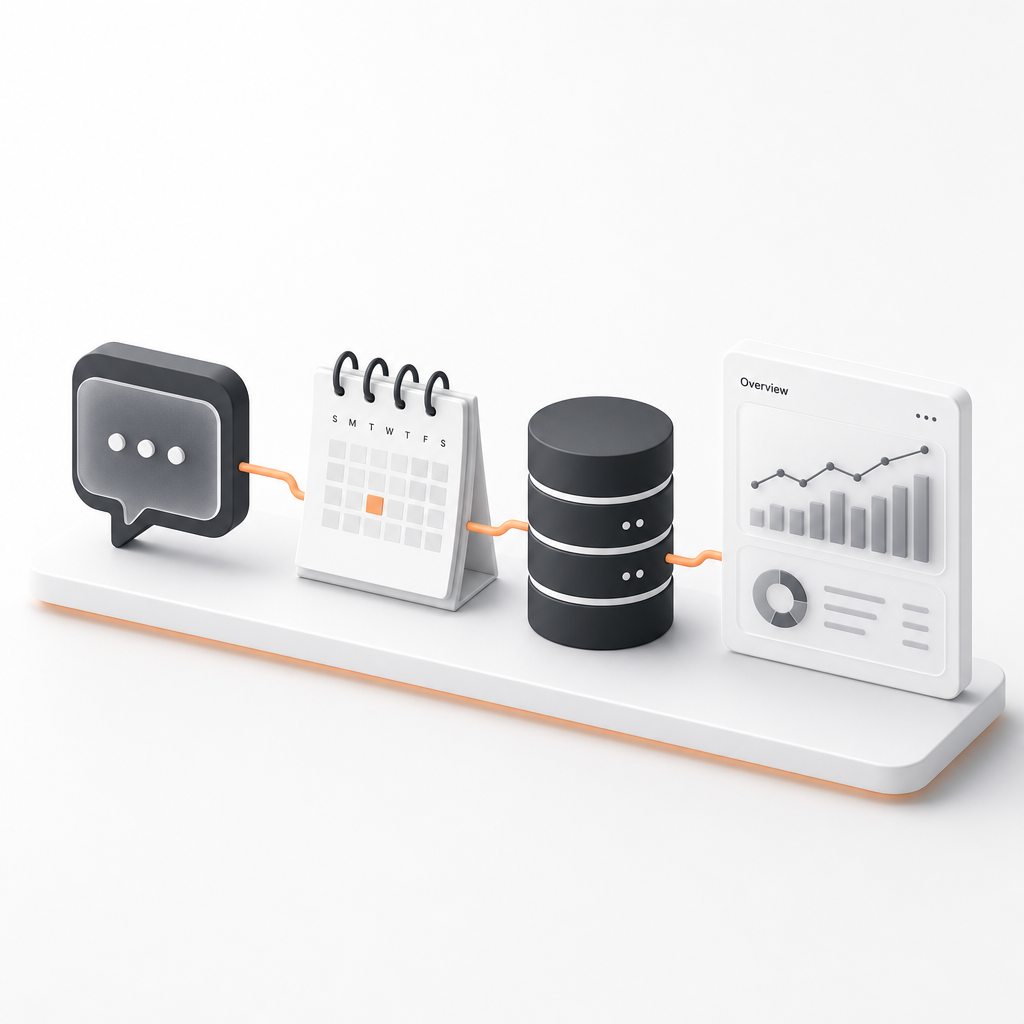
Most AI tools sold to allied health clinics automate a single slice of the patient journey. Vascue's live front-desk product focuses on patient communication and booking. Vascue Claims is a separate platform for healthcare providers with document-heavy insurance work. Its inputs include approved photos, screenshots, scans, PDFs, manual uploads, and connected practice records; Kenya and Cliniko are the first design-partner path. The two products can share approved context, but each keeps its own authorization boundary: a patient chat never turns into a filed claim on its own.
Zocdoc found that nearly half of the appointments on its platform were booked after hours. A journey that starts only when the front desk is staffed is already losing patients before they enter the system. Vascue closes that gap at the first stage and then carries the patient through every stage after it. This article walks through the journey as Vascue automates it, stage by stage.
What End-to-End Actually Requires
Before evaluating any tool, it helps to be precise about what end-to-end means for an allied health practice. It means the first patient contact is captured whenever it arrives. It means the booking is made without a staff member transcribing anything. It means approved context can move between authorized workflows without making a patient repeat it. It means claim preparation can begin from approved documents or system records without turning a public chat into an insurer-submission channel. And it means the practice manager can see where the operation is leaking time or money. Vascue is structured around those connected stages with explicit authorization boundaries.
The Vascue Patient Journey, Stage by Stage
1. First Contact Over WhatsApp
The journey starts when a patient sends a message, and for a growing share of patients that message arrives on WhatsApp, often outside business hours. Vascue connects to WhatsApp, with other communication channels also supported, and responds to every inquiry at any time of day without staff involvement. A patient asking about availability on a Sunday evening gets an answer that evening, not on Monday morning when a receptionist works through the backlog. Vascue treats that first message as the start of a managed journey rather than a voicemail to be returned later.
2. Booking Within the Same Conversation
Capturing the inquiry is only useful if it converts to a confirmed appointment. Within the same WhatsApp conversation, Vascue collects the intake information and confirms a booking before the patient closes the app. There is no manual entry step, and no risk of a booking being lost because it came in after hours and nobody transcribed it. Vascue carries the patient from question to confirmed appointment inside a single thread, which is the step most single-purpose reminder tools never reach.
3. One Connected Record
A confirmed booking is a relationship, not a one-off transaction. Because Vascue runs the intake and booking itself and syncs with the practice's Cliniko or Nookal (or another EMR), the patient's details stay together in one place rather than scattered across a missed message, a sticky note, and a half-filled form. This is the stage where most single-purpose tools drop the patient, leaving the front desk to piece the picture back together by hand. Vascue keeps the journey connected from the first message onward.
4. Insurance Claims and Pre-Auth in an Authorized Workflow
For an insurer-funded patient, the operational journey may continue after booking, but the claims boundary is different. Vascue Claims creates a source-linked draft from approved uploads or connected system records, validate the provider-side claim, retain staff authorization, and route through a configured payer channel. It is not an unattended continuation of the patient chat. See the insurance-claim automation guide.
5. Operations Visibility for the Clinician-Manager
The journey does not end at the booking. It ends, if it ends anywhere, at the operational decision a manager makes about how the practice runs. Clinicians promoted to practice management rarely receive formal business training. The operations layer Vascue has in development is aimed at that transition: it reads the journeys the front desk has captured and turns them into decisions, from sessions priced below their complexity to the slots where patients wait longest or quietly drop out. The aim is guidance through those decisions, not another dashboard to interpret.
What This Looks Like in Practice
A physiotherapy clinic can use Vascue to handle a WhatsApp enquiry and create a booking in its practice-management workflow. Insurance work is different: it depends on approved claim material, verified extraction, payer configuration, staff authorization, and external claim channels. A clinic might upload a referral photo and invoice, connect a source system, or combine both. The future product direction is a connected history with explicit boundaries, not an unattended conversational agent deciding coverage or filing a claim from chat.
How Vascue Compares to MIEA Health
MIEA Health publicly positions itself around clinic communication and practice-management integrations. Both products can be evaluated for front-desk workflows. Vascue's separate claims direction should be evaluated on its document intake, connected records, human-review controls, and configured payer routes, not as a conversational-receptionist feature. We compare tools in our AI medical receptionist roundup.
| If the priority is... | Consider... |
|---|---|
| Capturing after-hours inquiries | Vascue WhatsApp intake |
| Booking without manual entry | Vascue in-conversation booking |
| Insurance claim preparation from approved documents or records | Vascue Claims |
| Working alongside Cliniko and Nookal | Vascue |
| Operational visibility for a clinician-manager | Vascue (in development) |
| Post-appointment clinical notes | A dedicated documentation tool alongside Vascue |
For allied health practices, the useful goal is connected context with clear authorization boundaries. Vascue covers front-desk workflows today and is building the provider-side claims layer separately.
Book a demo and we will trace each stage of the journey on your clinic's setup.